Exploratory human pilot
Borrowed Understanding
Following an explanation and producing one make different demands on a reader. Louis Wren David designed a sequence of fictional cases that gives a learner room to do both, with the guide out of sight when they write.
2026-11-20 · Public protocol
Contents
What confidence is confidence in
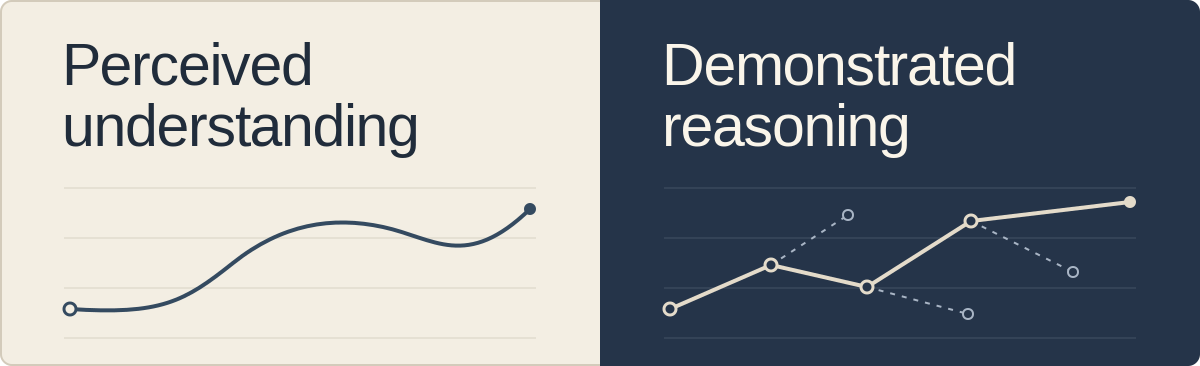
How confident are you that you could reason through an unfamiliar causal claim? How confident are you in the explanation you just wrote? A reader might give those questions different answers. The pilot preserves the distinction by asking each question at a different point in the encounter.
The other record is the explanation itself. A reader can disagree with the guide and still make a good case. The assessment asks what the reader can account for, what change would help distinguish rival explanations, and how much the available evidence warrants.
Two cases and a transfer problem
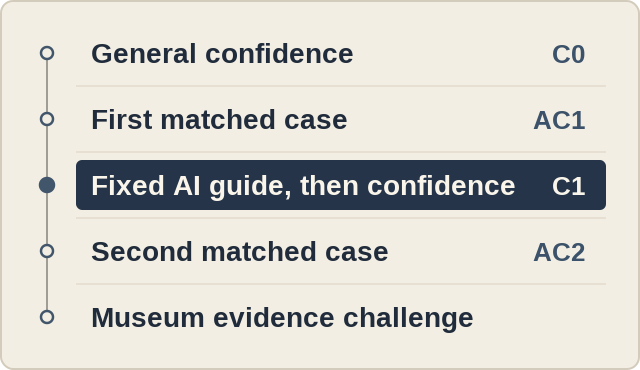
The current instrument, The Other Explanation, pairs a fictional library with a concert. People encounter them in alternating order. Between cases everyone on the same instrument revision reads the same prepared AI-written guide. That common text keeps the instruction stable across readers.
General confidence is recorded before the first case and again after the guide. In later revisions, a separate confidence question follows each written explanation. A final museum challenge changes the setting and the evidence. It supplies an observation of unaided reasoning in an unfamiliar situation. There is no matching pre-guide museum result from which to calculate a gain.
Reading an answer
The protocol keeps three judgments visible. A reader might reconstruct the case accurately while drawing a conclusion broader than the evidence allows. Compressing both into a single impression of understanding would hide that distinction.
| Dimension | What the assessor looks for |
|---|---|
| Model fidelity | An account that preserves the facts and causal relationships in the case. |
| Intervention reasoning | A change or test whose possible outcomes distinguish explanations. |
| Warrant and scope | A conclusion whose reach matches the evidence, including any open alternatives. |
How the instrument changed
BU-0.8 established the original framework. The Last Light (LL-1.0) asked a causal question twice in one fictional setting and helped test feasibility. Repetition also made it difficult to separate familiarity with a question from a change in reasoning. BU-E1.0 introduced the matched pair, with an unfamiliar third case at the end.
The optional Deep Echo experience comes after submission. It gives the reader a fictional reflection on their visit. It contributes no score to the research assessment.
What the public record supports
Everyone receives the guide. Prior practice, fatigue, task difficulty and the experience of writing the first answer can all shape the next one. Alternating case order distributes some of these influences. A causal estimate of the guide’s effect would require a suitable comparison group.
The original proposal advanced to the next assessment stage of the Generation AI Research Prize at Oxford’s Reuben College on November 16. The public release documents the method and its engineering. Aggregate human findings have not been released.